
Montague Court Records After Arrest
After a Montague County arrest, the jail roster and the court record serve different jobs. The roster is a custody tool managed through the sheriff-linked jail system. It can help confirm whether someone is in the Montague County Detention Center and may provide booking context if the detail page loads. The court record is the case file side. It begins when charges are filed, presented, or otherwise opened in the court system.
The official county District Attorney page lists Katie Boggeman as District Attorney, while the County Attorney page lists Clay V. Riddle. Felony and serious criminal matters often involve the district attorney and district court system; county-level matters may involve county attorney functions. Local research did not publish a complete division chart, so the safer route is to use the online court-record channels and contact the right clerk when the case level is unclear. For custody and booking details, use jail inmate records; for booking-photo questions, use jail roster mugshots.
Search Court Records After Arrest
The Montague County District Clerk page links to an online court records search at the Tyler portal. It also states that, effective September 1, 2025, the District Clerk's Office is fully integrated with Research Texas for certain orders, so attorneys and parties can access orders through that statewide system. The portal host did not resolve from command-line capture during research, but it remains the official county-linked path.
- Confirm custody or booking context through the jail roster or jail phone when the arrest is recent.
- Open the county-linked Tyler court records portal for online case lookup.
- Search by defendant name or case number when the portal offers those fields.
- Open the case record and compare filed charges with the booking or arrest charges.
- For orders covered by the clerk's notice, use Research Texas or call the District Clerk at 940-894-2571.
Older files, sealed records, restricted documents, or portal outages may require a clerk request. The District Clerk page says records requests can be emailed to mcdc@co.montague.tx.us using the District Clerk Record Request Form, and payments can be made through the District Clerk's Pay Miscellaneous Fees option when a payment ID is included.
Montague County Case Search Fields
The research captured official court links but not a full field-by-field case-search form. Treat the following table as the verified access inventory, not a promise that every search screen displays the same labels in every browser session.
| Channel | Type | Use | Notes |
|---|---|---|---|
| Tyler portal | Web portal | Online court records search | Official county link; hostname did not resolve during command-line capture. |
| Research Texas | Web app | Orders and state court-record access | Referenced by District Clerk for orders after September 1, 2025. |
| District Clerk request | Email/form process | Records not available online | Use the District Clerk Record Request Form and include Payment ID when paying online. |
The District Clerk page screenshot shows the local clerk contact and records-request instructions.
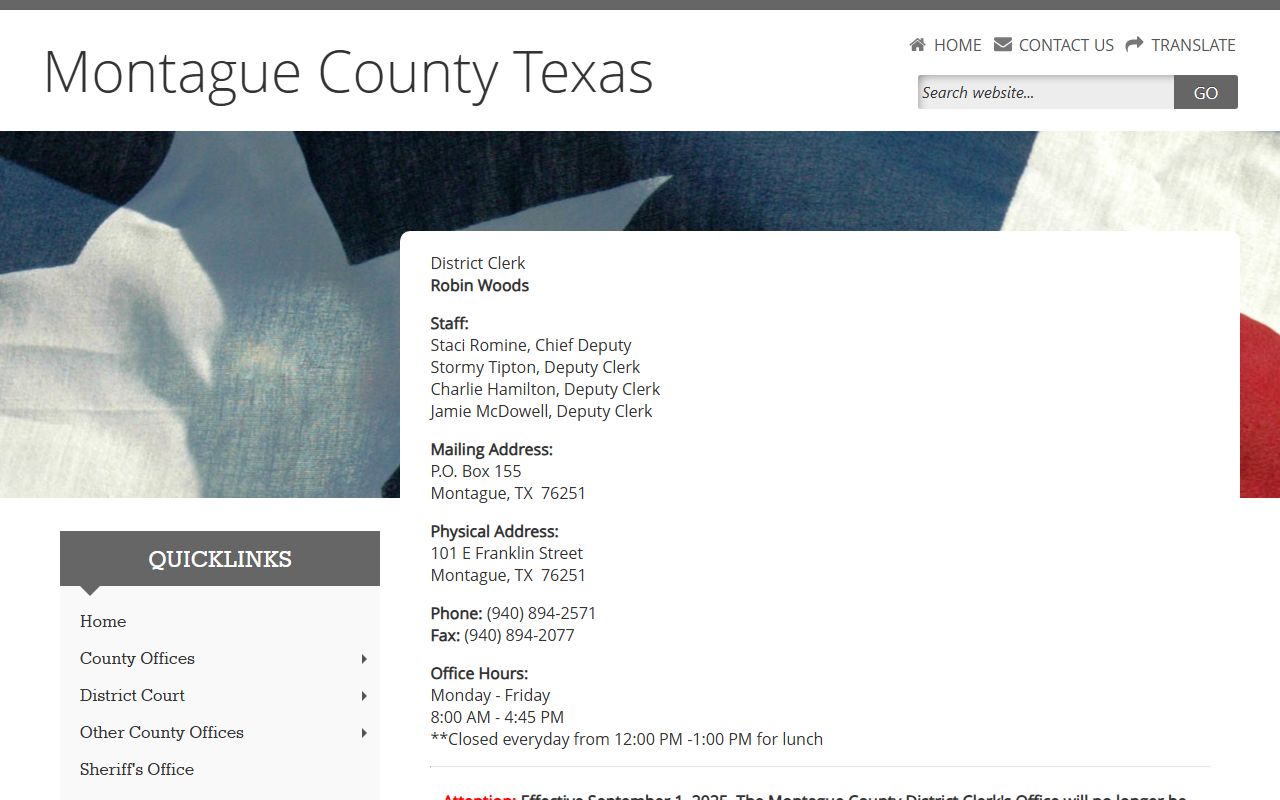
That local clerk page is the better source for request routing than the jail roster once a court case has opened.
Charges Filed After Arrest
Roster charges and court charges can differ. The arresting agency may enter an initial charge or hold during booking. The prosecutor may then file, amend, reduce, dismiss, or replace the charge in court. In a felony case, the filed court record may change again after grand jury action. That is why court records after a jail arrest should be read as the formal case path, not just as a copy of the booking line.
| Document | What It Means | Typical Role |
|---|---|---|
| Complaint | A sworn allegation or charging statement. | Often appears early in a criminal case. |
| Information | A prosecutor-filed charging document. | Used where Texas procedure allows prosecution by information. |
| Indictment | A grand-jury charging instrument. | Common in felony prosecution after presentation to a grand jury. |
Montague Charge Status Terms
A court case can change after the first arrest entry. A charge can be pending while the case is active, amended when the prosecutor changes its wording or level, dismissed when that count ends without conviction, or resolved by plea, verdict, deferred disposition, or another court order. The court record, not the current inmate roster, is the better place to follow those changes.
| Status | What It Means |
|---|---|
| Pending | The charge or case is still active and no final disposition appears. |
| Amended / reduced | The prosecutor or court changed the charge from its earlier form. |
| Dismissed | The charge ended without conviction on that count. |
| Disposed | The court has entered an outcome, such as conviction, dismissal, acquittal, or deferred result. |
| Warrant / hold | A court or agency action may keep the person in custody or require a court appearance. |
Bond After Montague Arrest
Bond is part of the arrest-to-court pathway because it affects whether a person stays in the jail population while the case proceeds. Texas procedure routes an arrested person to a magistrate for Article 15.17 warnings and bond decisions without unnecessary delay and no later than 48 hours after arrest. Bond may later change by court order.
The sheriff publishes an approved bail bonds page, but the detailed list was not captured in the text extraction. The sheriff mail and commissary page adds one important local rule: dispatch accepts inmate bond money only and does not accept commissary money. Do not use the commissary process as a substitute for bond instructions.
| Bond Type | How It Works |
|---|---|
| Cash bond | The full court-set amount is posted directly in approved funds. |
| Surety bond | A licensed bail bond company posts bond and assumes surety obligations. |
| Personal recognizance / PR bond | The court releases the defendant on a promise to appear, often with conditions. |
| No-bond or hold | Release is blocked by a court order, warrant, parole hold, TDCJ hold, ICE detainer, or another agency hold. |
Warrants and Arrest Records
No official Montague County sheriff active-warrant search table was located. The sheriff site has a Most Wanted Person page and a Crime Stoppers connection, but static extraction did not show a searchable warrant database. A warrant may still lead to a jail booking, and once the person is booked, the Inmates In Custody roster may be the first public sign of custody.
Bench warrants often come from court cases, such as failure to appear or violation of a court order. Arrest warrants may arise from probable cause or a charging document. Search the court case record, contact the issuing clerk, or call the jail for custody status if a warrant may have led to booking. Do not rely on a county roster to clear or resolve a warrant.
Charges vs Convictions
An arrest or filed charge is not a conviction. Court records after a jail arrest can show accusations, amendments, settings, and status updates before the case is resolved. The final court disposition is the part that tells whether a charge ended in conviction, dismissal, acquittal, deferred action, or another outcome.
| Charge | Conviction | |
|---|---|---|
| Stage | An allegation or filed count. | A final finding, plea, or verdict. |
| Proof | Begins with probable cause or filed accusation. | Requires plea, verdict, or other final court action. |
| Where to confirm | Charging document and docket entries. | Judgment, disposition, or final order. |
Sealed Expunged Arrest Records
Texas Code of Criminal Procedure Chapter 55A governs expunction of qualifying criminal records. Expunction is not the same as a website edit or a casual correction request. It is a court process. A dismissal or eligible outcome may support a records-clearing request, but the specific path depends on the case, charge, timing, and court order.
| Sealed / Restricted | Expunged | |
|---|---|---|
| Public view | Hidden or limited from public access under court rules. | Removed or treated as not existing for many purposes after order. |
| Access | Some agencies may retain limited access. | Access is more limited and controlled by the expunction order. |
| How it happens | By statute, court order, or eligibility rule. | By a qualifying petition and court order under Texas law. |
Restricted Court Records After Arrest
Some records tied to a Montague County arrest may not be available online. Juvenile matters, sealed cases, expunction-eligible records, some law-enforcement records, and active investigation materials can be withheld or limited. The Texas Public Information Act provides access to governmental records, but it also contains procedures and exceptions.
For law-enforcement files outside the court case, use the sheriff open-records process. For court files, use the clerk path. The District Clerk's physical address is 101 E Franklin Street, Montague, TX 76251, with mailing at PO Box 155, Montague, TX 76251. Office hours are Monday through Friday, 8:00 AM to 4:45 PM, closed from 12:00 PM to 1:00 PM for lunch.
Important: Public record lookup is not a substitute for legal advice or an FCRA-compliant background check.